

Terra Incognita
(Travel Narrative)

Pole to Pole
(Travel Narrative)

I May Be
Some Time
(History)

Skating to
Antarctica
(Biography/Memoir)

Antarctic
Navigation
(Fiction)

Antarctica
(Science Fiction)

The Worst Journey
in the World
(History)

Below the
Convergence
(History)

Alone: the
Classic Polar
Adventure
(History)

Scott's Last
Expedition
(History)
Fresh off the plane, we were ushered through the efficiency of Barcelona International Airport. The airport was built during the extensive modernization effort by President Juan Carlos for the hosting of the 1992 Olympic games in Barcelona. This effort also has touched the rest of Spain, from sleek glassy high-rises to massive river dam projects. However, as we soon discovered, there lay a multitude of impression in this country.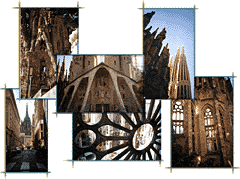
At the heart of Barcelona is the Gothic Quarter. In contrast to its 17th and 18th century architecture one can find the face of America -- McDonalds, Disney Characters, tennis shoes, and such. The juxtaposition of the narrowly bricked corridors, ancient shops, and ornate cathedrals just off the wide busy streets caused a sense of time colliding. The most impressive of these contradictions is the Church of the Sacred Family (photo montage). Building began in the late 1700’s but was abruptly stopped when money ran out. Several hundred years later the modern architect Antonio Gaudi proposed a new design to finish building this Church. These designs came to be realized recently and are still being completed today. When finished, it will be a most unusual and beautiful structure, combining the old and new. This kind of contrasting beauty typifies the layout and character of cosmopolitan Barcelona.
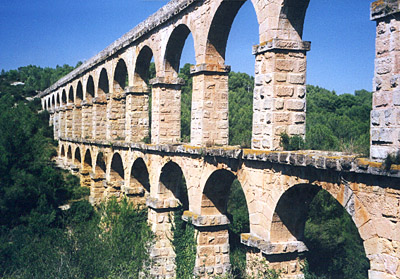 Just south of Barcelona coming down into Tarragona, almost hidden off the side of the highway was a Roman aqueduct ruin. About a third of a mile long, we had the run of the place for about two hours without seeing another person. After several hundred years of use the stone was smoothly worn and breached so that the water channel must have leaked profusely. Unused, it lies a few hundred yards from a more modern ruin -- a cement-walled house. Equally breached from repeated shelling, it was the reminder of some forgotten battle at the turn of the century. The Roman aqueduct, as the only witness, remains untouched (photo).
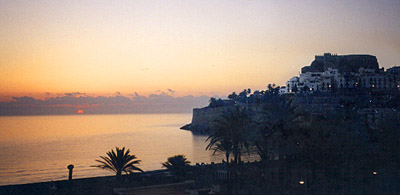 Further south, the honeymoon began in earnest at the quiet seaside town of Pensacola (photo). Guarded by a castle at the end of a spit, we were charmed to find a white city, markets, and impromptu plays along its winding streets. A Spaniard’s weekend resort, it was less busy and retained its small town feel, despite the usual accoutrements of tourist attractions. It is a better find than some of the more-well known destinations.
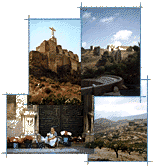 Continuing down toward Costa Del Sol, we came to realize the influence of history over the place and people we passed. Above the towns, a hill of any importance had a castle ruin on it. For those castles of significant strategic value, ruins were rebuilt as many as four times, each bringing its unique character -- Greek, Roman, Moor, Christian (photo montage). Again, the juxtaposition of styles on top of each other colors the tone and mood as one travels the countryside. In moving from north to south, the tone noticeably began to shift from Christian influence to Moorish.
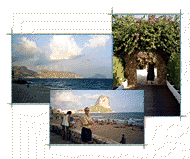 At Costa Del Sol, its fame showed. The beaches are spectacular; but, even late in the season they are crowded. Benidorm is wall-to-wall 50 story glass towers with no vacancy and more being built. Just north of Alicante on a rocky cliff overlooking the Mediterranean, one can find quiet a resort condo. It is perhaps one of the most romantic getaways we found. The accommodations are lavish, private and inexpensive. We had no problem finding a room, and a short drive away we could find the famous sand beaches of Costa Del Sol and, of course, sun (photo montage).
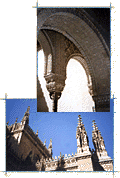 Further south beyond Costa Del Sol, the landscape becomes more rugged as it begins to skirt the southern mountain range. Nestled in this terrain, we found the last Moorish stronghold, Granada. What is left of the Sultan’s palace is unlike anything in Spain. The ornate Islamic stonework is truly an experience and a must see if one ventures this far south. Built onto this palace are Christianized structures that attempted to reduce the past evidence of such practices as polygamy. Enough is still intact to demonstrate the grace and elegance devoted to Islamic architecture that rivals anything in Europe (photos).
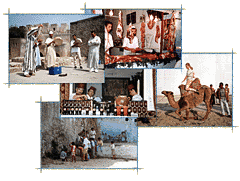 With Granada whetting our appetite, we booked a day cruise to Tangier to further immerse ourselves in Islamic culture. That morning the Strait of Gibraltar was lightly fogged in as our hydrofoil jetted across to Africa. As we slowed into the harbor of Tangier, above us along the wave breaks were lines of Muslim men, fishing, emerging from the fog one by one, watching us drift in. With their faces pressed against the glass windows, we made our way through customs and into the arms of tour guides. Tangier was a surprisingly clean and vibrant place and noticeably lacked Spain’s olive / gin / diesel smell. With little automobile traffic or modern fixtures, we definitely felt that we had left Spain behind. Despite the many attempts to con us out of our money and the canned nature of the tour, we found Tangier an intriguing day trip and a welcome departure from western culture (photo montage).
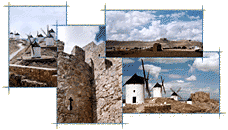 Heading back north again through the interior of Spain, we passed through vast stretches of olive orchards and ranches from where bulls are born to fight the matadors. In this countryside just outside Mora, we happened upon Don Quixote’s castle. Under extensive restoration, the castle and its windmills are being rebuilt to the period. With a commanding view of a fertile plain, it made for a fascinating historical journey into one of the famous legends of Spanish history (photo montage). We had the run of the castle for the day; but, a real treasure awaited us just a few miles down the road.
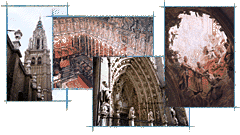
Just south of Madrid and west of Mora is Toledo. Situated on a small river island, the city of Toledo has been preserved in all its original splendor. The city contains one of the wealthiest Catholic churches of its time period and boasts some of the finest architecture, art, and treasures in Europe (photo montage). In many shops you can still watch the handcrafting of detailed gold work, art, and ceramics. The nights are replete with traditional dances and performances. The siesta, like the rest of Spain, rules the afternoon. With an amazing vista over the city, we stayed several days and lost ourselves in what seemed a 16th century Europe.
Having run out of time to discover the galleries of Madrid and the likes of Pablo Picaso, we boarded our plane for the flight back to the States, saving them for a later time and another impression.
-- by Tony Medeiros, Cendant Interactive Services.
Editor: Tammy Currier
 |
 |
 |
To the Pole (Travel Narrative) |
Poles Apart (Photography) |
Polar Dreams (Travel Narrative) |

